

Harakiri
The Ritual of the Cut and the Weight of Honor

Sometimes I say I want to do a harakiri out of pure honor for having failed so many times in life. I say it with a dramatic flair, almost as if I were playing a tragic character in a grand old play. I do not mean it literally. I wouldn’t, I swear. But there’s something in the image that tempts me. The thought of slicing open the belly, metaphorically, just to spill every mistake, every regret, every missed chance onto the floor like the inner contents of my dignity. It feels strangely noble, even comforting, to imagine that failure could be addressed with something as final and precise as a blade.
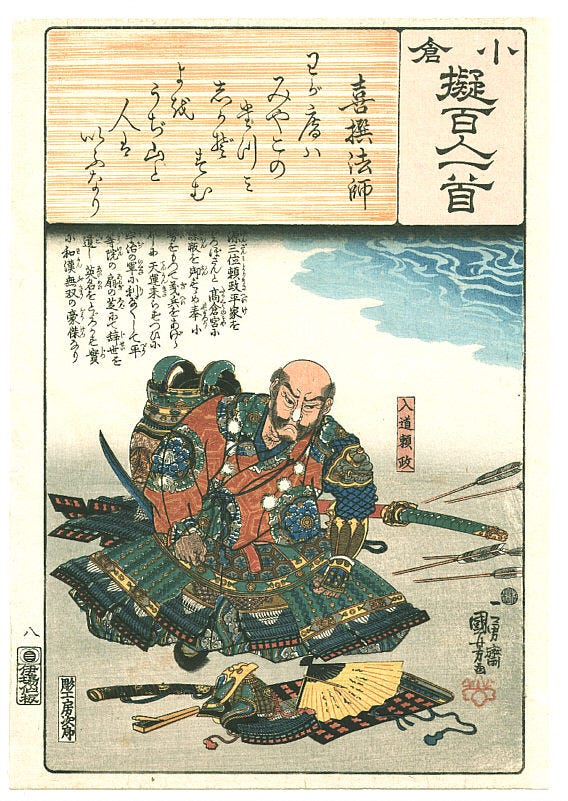
But harakiri, or seppuku, was not metaphor in the world it came from. It was blood. It was silence. It was ceremony and consequence braided tightly together. This ritual took root in twelfth-century Japan, during the time of the samurai, where it was seen as a way to preserve one’s honor in the face of disgrace. The first recorded instance was that of Minamoto no Yorimasa, who, upon suffering defeat in battle, chose to end his life by opening his stomach. His act was not desperate. It was precise and composed. The cut was a statement. It declared to the world that though his sword had failed, his spirit had not.
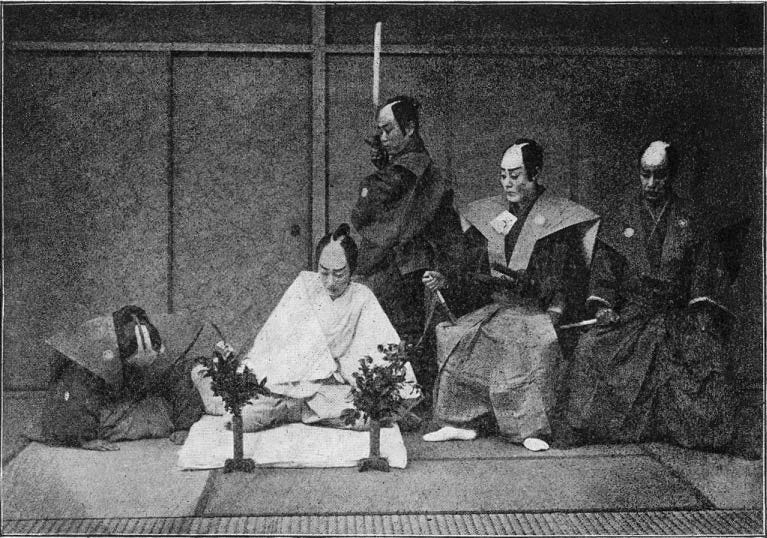
In those centuries, harakiri was never done in secrecy. It was a public performance of resolve. The person performing the act would wear a white kimono, a color of death and purity, and sit on a special mat. He would write a death poem, clean his blade, and cut into his belly from left to right. A second would stand by, a trusted friend or follower, to decapitate him at the right moment and end the pain. This companion was not there to interfere, but to complete the ritual. To witness and honor it. The cut was not merely physical. It was spiritual. It was an incision into the soul.
Over time, harakiri became codified in law. It was sometimes commanded by the state as a punishment for crimes among the samurai class, or used voluntarily to protest political decisions.
In the famous tale of the 47 rōnin, the warriors avenged their master’s death and were then sentenced to die by seppuku. They obeyed. Their death was not seen as tragic, but glorious. Loyalty had been fulfilled. The ritual had tied the knot between justice and death.
I think about that kind of clarity sometimes. About how clean it seems to face one’s shame, to answer it with an act that leaves no room for excuse.
I think of Mishima, the modern writer who slit open his stomach in 1970 after staging a speech in defense of traditional Japanese values. His death was grotesque and theatrical, but it was also a performance of belief. A refusal to live disconnected from his ideals. That part haunts me. Not the blade itself, but the certainty behind it.
Of course I would not do it. I say it, but only as a way to hold up the mirror. I fail, like anyone. I collect small shames in quiet places. But I also live. I drink water and lots of soda. I write. I read. I crack my knuckles. I fall in love. Still, there is something strangely elegant in the image of harakiri, in the thought that there once was a world where a person could meet their errors eye to eye, and answer with a gesture that said, I take responsibility. I end it with honor. In my own way, I think I long for a version of that.
Just the courage. Just the ritual.
Maybe writing is the new cut. Maybe every word I spill is a small act of seppuku. No blade, just truth. No blood, just memory. And a quiet hope that by opening something, I can close something else.
Happy Easter,
Hazelle Galeas